What is a neocloud, and why is the market suddenly freaking out about them?
Erik Isakson/Getty Images
- The neocloud panic has rattled a key part of the AI trade lately.
- "Neocloud" encompasses cloud computing providers that primarily focus on AI services.
- The subsector has plunged recently amid broader funding concerns and fears AI investment may slow down.
What the heck is a neocloud?
It's a question you might have asked yourself while parsing headlines about growing investor panic in the space in the last few week.
Concerns have been quietly building in recent months, but only recently escalated to the level of major market risk, resulting in a rout that's spilled over into the AI and chips sectors. The Roundhill Neocloud ETF is now down around 31% since its inception this summer.
The sector briefly sold off again on Monday, spooked by bearish comments from Elon Musk, before reversing course to edge higher.
Here's everything you need to know:
What is a neocloud?
Neocloud is a fancy buzzword for a company that basically provides cloud computing services for AI customers. While other cloud providers, like Amazon Web Services or Microsoft Azure, host things like websites and databases, neoclouds focus almost entirely on services related to AI tasks, with the business model built on a model of leasing GPUs and networking capacity to customers for model training and inference.
Many of these companies, including the largest among them—CoreWeave—began life as crypto miners, using high-end GPUs to perform the cryptographic grunt work needed to mint new bitcoins. Until the last few weeks, their stocks had been on a tear in 2026. Nebius, one neocloud darling that has signed multibillion-dollar AI infrastructure deals with Meta and Microsoft, saw its stock price more than double from the start of the year through its peak mid-June. CoreWeave shares surged more than 70% from the start of the year through its May peak.
But the parabolic rally has sputtered. Jitters have been building over the neocloud space all month, with investors still feeling uneasy about the business outlook for these firms, even as Nvidia CEO Jensen Huang assured markets last week that neocloud demand was off the charts.
The concerns run in two streams: In one, the idea is that higher rates have choked the market for AI debt, cutting off capital at a time when the industry is still rapidly building. In the other, investors are worried that companies may be spending too much on AI infrastructure, particularly when the final return on investment and the distribution of AI gains remain unclear.
How we got here
October 14: CoreWeave's bonds slip into distressed territory
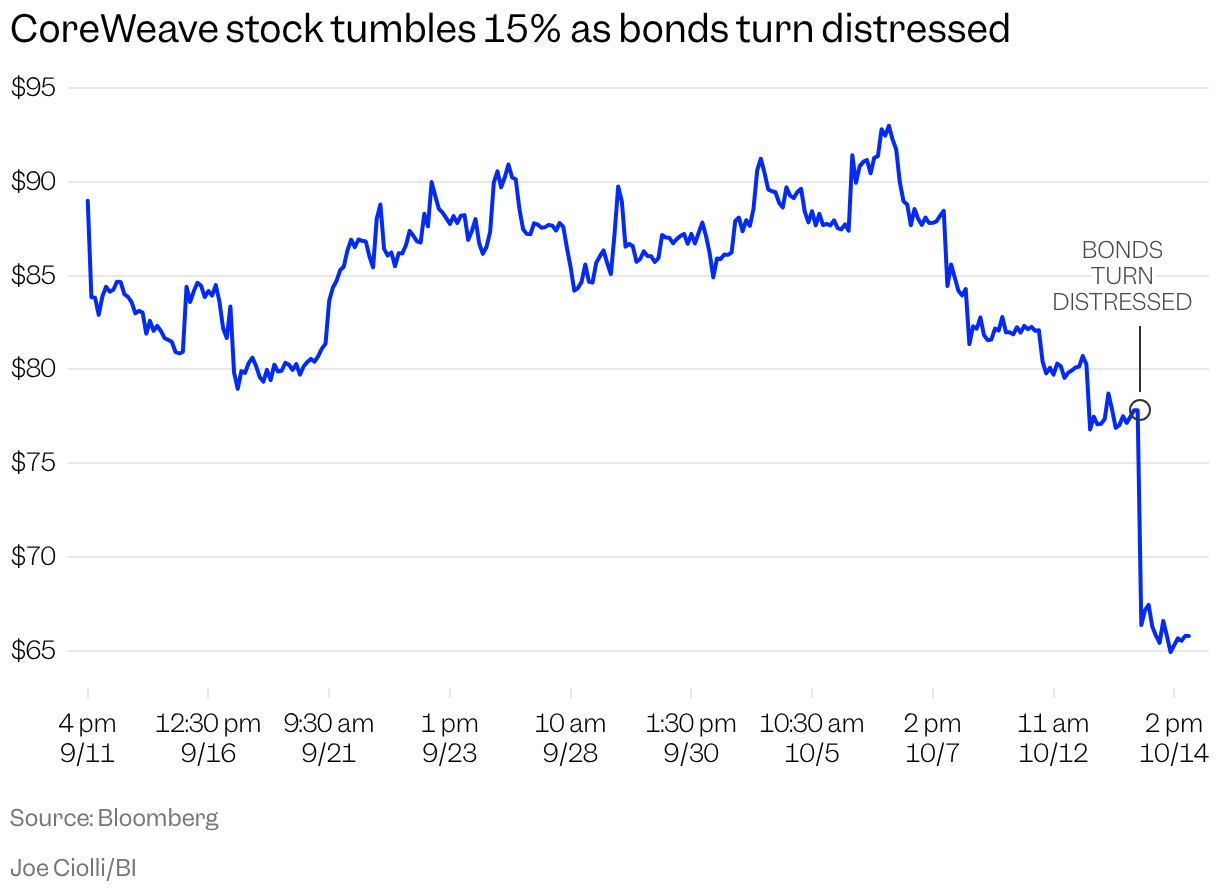
The fears began percolating in the middle of this month, when the value of CoreWeave bonds fell below 80 cents on the dollar, a level typically associated with distressed companies. The decline reflects several different factors, such as investors pricing in higher risk associated with holding the debt, more debt being issued recently relative to demand, and higher interest rates, which drag bond prices lower.
Venture capitalist Chamath Phalipitiya posted about CoreWeave's bonds on X, including an analysis that theorized that AI is blowing up a private credit bubble.
Elon Musk responded "Yikes," drawing more attention, which ultimately sparked a steep plunge in CoreWeave's stock.
Shares are down 28% in the last two weeks.
October 14: Gartner predicts most neocloud firms will fail by 2030
That same day, the research and advisory firm Gartner also released a report predicting that 80% of neoclouds would stop operating by 2030.
Researchers projected that AI revenue would be "insufficient" to support returns on all AI capex over the following years.
The firm pointed to the $6 trillion in AI investment spending expected between 2027 and 2030. Given the current pace of spending, AI data center owners would need to generate around $8.5 trillion in revenue to cover the capital spending and financing costs, though enterprise and consumer AI data center revenue is forecast to only reach $3.6 trillion by 2030, the firm said.
"Neoclouds will be among the most exposed to the imbalance between revenue and capital spending. Hyperscalers, for example, have massive and highly diversified revenue sources that could plausibly sustain AI investments for years. On the other hand, neoclouds must soon earn returns on AI-optimized IaaS and associated platforms to sustain operations," Gartner wrote, adding that the AI space could see around $4 trillion in asset value write-downs through 2032.
The Roundhill Neocloud ETF plunged 11% in a single day.
More panic wafted over the space that day as DA Davidson analyst Gil Luria said on a podcast that CoreWeave stock could fall to $0 if the AI spending boom falters. The comments drew more attention to AI capex ahead of mega-cap tech earnings.
October 16: Chip stocks lose $1 trillion
A global sell-off ripped through the chip, memory, and neocloud sectors. Weekly losses in the chips sector hit $1 trillion in value.
The losses appeared to be the steepest among neoclouds as concerns about AI debt rose. The Roundhill Neocloud ETF shed another 11%.
October 20: South Korea's Elice flops post-IPO
Elice, an AI cloud and data center operator, flopped after going public on the South Korean market, weighing on sentiment in the broader AI space. Shares of the neocloud firm cratered by 32% on their first day of trading.
October 21: Meta and Tesla report earnings
Meta and Tesla jolted markets after reporting third-quarter earnings. While both AI giants beat on the bottom line, they signaled more spending discipline in their capex guidance, adding to the overall anxiety about AI investment slowing down.
The Roundhill Neocloud ETF dropped another 8% on Thursday as investors took in the results.
October 25: Elon Musk warns of widespread failure among neoclouds
In a post on X, Musk said debt markets had nearly shut off for AI companies that weren't generating "substantial revenue" outside of data centers.
"That means the 200+ neoclouds are going to see guppy-level death and consolidation. Some will make it through, but not many," he wrote on the platform Sunday afternoon.
Neocloud stocks dropped, with the Roundhill Neocloud ETF losing as much as 4% Monday morning before paring the losses. These were the sector's most notable moves:
Musk's comments appear to have sparked another round of "skittish trading," analysts at Jefferies wrote in a note.
JPMorgan said AI debt markets appeared more "discriminating" on AI infrastructure, but brushed off fears that there could be a "broader funding crisis" that impacts the AI sector.
"The credit environment is troubling especially but the consensus, now, seems to be that hyperscalers are fine and that the big players will continue to dominate but that ROI remains positive for smaller players, including neoclouds," strategists on the bank's market intelligence team said. "The biggest concerns are growing debt issuance, interconnected finance arrangements, higher borrowing cost and the ability to deliver compute capacity on-schedule."
from Business Insider https://ift.tt/rHsIWdO
via IFTTT


Comments
Post a Comment